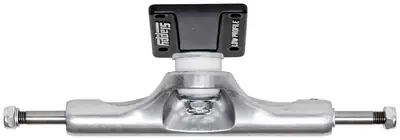
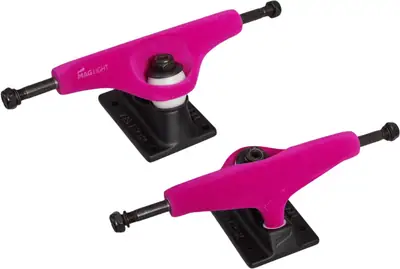
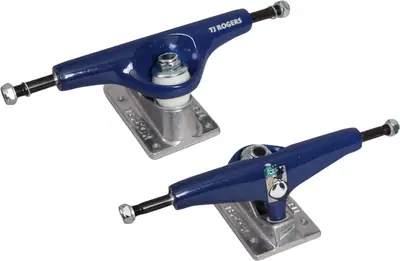
Skateboard bushings, often referred to as truck rubber or cushioning, are crucial components of your skateboard setup. They influence how your board manoeuvres, reacts, and feels when you ride.
- Hard bushings offer enhanced stability and potentially a quicker response.
- Softer bushings simplify turning and steering the skateboard with minimal effort.
Overview

Understanding Skateboard Bushings
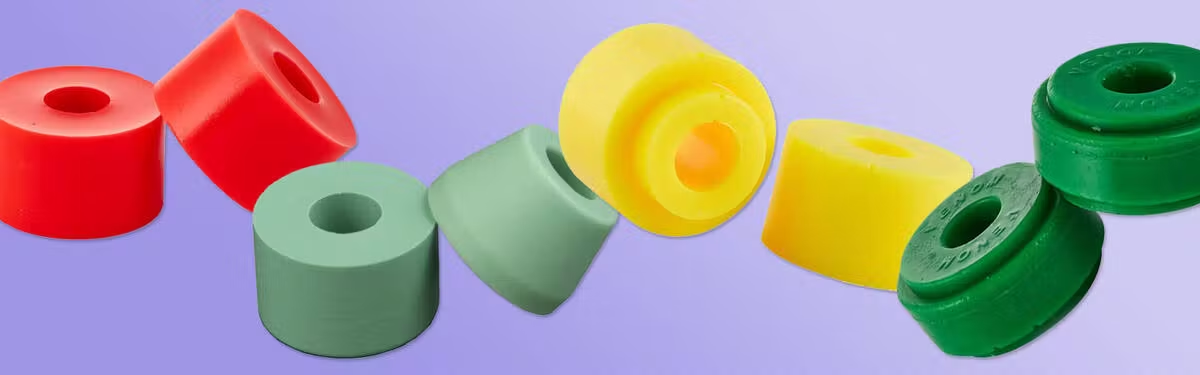
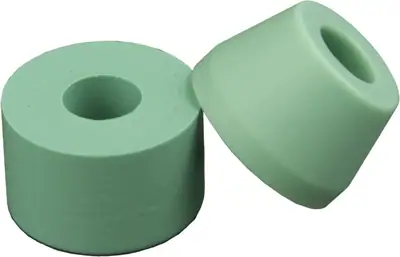
Skateboard bushings are urethane rubber parts, either cylindrical or conical, located on the kingpin of the trucks. They are essential for steering and controlling the skateboard, greatly affecting your board’s characteristics.
A skateboard truck includes two bushings:
- Top bushing – oriented downward toward the ground.
- Bottom bushing – oriented upward toward the deck.
The bushings change shape according to your weight shifts on the deck, causing the trucks to pivot and alter your direction. The degree of pivoting dictates the sharpness of your turns, and the effort required to achieve this depends on how readily the bushings conform to your movements.
→ Your bushing's firmness or hardness is key to balancing agility, responsiveness, and stability.
Skateboard Performance and Bushing Firmness
- Softer bushings lead to looser trucks, simplifying turning.
- Harder bushings resist pressure, making trucks tighter and more stable.
Indicators You May Need Harder Bushings
If your board feels overly loose:
For those experiencing speed wobbles or feeling excessive looseness in trucks that lack stability, firmer bushings are recommended.
If wheelbite issues arise:
Harder bushings help to mitigate wheelbites. Always verify truck tightness first and consider the potential benefit of risers.
If the kingpin nut is fully cranked:
If the threading is visible on the kingpin or bushings appear deformed under the washer, harder bushings might be needed. A hint: If you have extra washers that fit, placing one or two beneath the truck bushing washer can reduce exposed threading.
Signs You Might Need Softer Bushings
If steering and initiating turns are challenging:
Softer bushings will lessen the effort required to turn.
If you enjoy carving and cruising:
Softer bushings allow for more fluid, sharper turns when carving.
If a loose and responsive feel is your preference:
Aboard with easily accessible turning and sensitivity to slight shifts is achievable with softer bushings for that fluid, responsive feel.
Some skaters prefer significantly looser trucks, sometimes even removing top bushings for extremely (but rattly) flexible trucks (note: this practice is not recommended).
The Role of Body Weight in Bushing Toughness
Your body weight affects bushing malleability: heavier individuals can more easily manipulate bushings, while lighter riders might require softer bushings for similar responsiveness.
We've compiled a table outlining suggested bushing hardness based on user weight. Remember that weight is only part of the equation, with personal preference playing a significant role. This chart offers rough guidance for those starting to explore varying bushing hardness options.
→ The best benchmark is your current bushings. Knowing their durometer rating allows you to move to a harder or softer feel by adjusting this scale.
| User Weight (kg) | Rider Weight (lbs) | Softer / Looser Setup (Durometer) | Stiffer / Tighter Setup (Durometer) |
| <65 kg | <143 lbs | 81A - 85A | 86A - 90A |
| 65 - 80 kg | 143 - 176 lbs | 86A - 90A | 91A - 95A |
| 80 - 90 kg | 176 - 198 lbs | 91A - 95A | 96A - 100A |
| >90 kg | >198 lbs | 96A - 100A | 100A |
Children's skateboards feature bushings matched to their weight for optimal performance. Likewise, new trucks come with pre-installed bushings suited for a range of skaters, with wider trucks typically using slightly firmer bushings than narrower ones.
→ When selecting a new complete skateboard or trucks with pre-installed bushings, consider the width of both the skateboard and trucks for compatibility.
Impact of Bushing Shape on Skateboard Function
Bushings have varied shapes, affecting truck behaviour.
- Conical (cone-shaped): often used as a top bushing, prioritizing responsiveness.
- Barrel-shaped (straight): commonly a bottom bushing, enhancing stability.
A cone on top paired with a barrel below maintains balance, while dual barrels add steadiness and swapping positions favours responsiveness.
Adjusting the Kingpin Nut for Desired Truck Tightness
- Tighten (clockwise) the kingpin nut for firmer, less agile trucks.
- Loosen (counter-clockwise) to facilitate easier turning.
If you find initiating turns difficult, loosening the trucks might solve the issue. Conversely, if trucks feel too loose and you're struggling to maintain control, consider tightening slightly.
Recognizing When Bushings Need Replacement
Look for indicators of wear like cracks, splits, or stickiness in your bushings, as these decrease effectiveness. When worn, opting for new bushings is better than over-tightening your trucks.
If your board's response is satisfying and bushings remain intact, there's no need for immediate replacement. However, once wear becomes evident, action will be necessary. In need of new bushings? Find what you seek here: